Mastering Java Coding Interviews: Top 10 Questions
- Sahadev Bite
- Jan 7
- 4 min read

Updated: Feb 18
Understanding Core Java Concepts
Java is a versatile and widely-used programming language. Interviewers often focus on core concepts. Here are some essential questions that test your foundational knowledge.
1. What are the main features of Java?
Java is known for several key features:
Platform Independence: Java code runs on any device with a Java Virtual Machine (JVM).
Object-Oriented: Java supports encapsulation, inheritance, and polymorphism.
Robust and Secure: It has strong memory management and security features.
Multithreaded: Java supports concurrent execution of two or more threads.
Automatic Memory Management: Java uses garbage collection to manage memory.
These features make Java a popular choice for enterprise applications and Android development.
2. Explain the difference between JDK, JRE, and JVM.
JDK (Java Development Kit): Contains tools for developing Java applications, including the compiler and debugger.
JRE (Java Runtime Environment): Provides libraries and JVM to run Java applications but does not include development tools.
JVM (Java Virtual Machine): Executes Java bytecode and provides platform independence.
Understanding these components is crucial for both development and troubleshooting.
Common Java Coding Interview Questions
3. What is the difference between `==` and `.equals()` in Java?
`==` checks if two references point to the same object in memory.
`.equals()` checks if two objects are logically equal based on their content.
For example:
```java
String a = new String("test");
String b = new String("test");
System.out.println(a == b); // false
System.out.println(a.equals(b)); // true
```
This distinction is important when comparing objects like Strings, where content equality matters.
4. How does Java handle memory management?
Java uses automatic garbage collection to manage memory. Objects are created in the heap, and when they are no longer referenced, the garbage collector frees up memory. This process helps prevent memory leaks and improves application stability.
5. What are the different types of exceptions in Java?
Java exceptions are divided into:
Checked Exceptions: Must be handled or declared in the method signature (e.g., IOException).
Unchecked Exceptions: Runtime exceptions that do not require explicit handling (e.g., NullPointerException).
Errors: Serious problems that applications should not try to catch (e.g., OutOfMemoryError).
Handling exceptions properly is essential for writing robust Java applications.

Practical Coding Questions and Solutions
6. Write a Java program to reverse a string.
Reversing a string is a common coding exercise. Here's a simple method:
```java
public class StringReversal {
public static String reverse(String input) {
StringBuilder reversed = new StringBuilder(input);
return reversed.reverse().toString();
}
public static void main(String[] args) {
String original = "JavaInterview";
System.out.println("Reversed string: " + reverse(original));
}
}
```
This uses `StringBuilder`'s built-in `reverse()` method for efficiency.
7. How do you implement a singleton pattern in Java?
The singleton pattern ensures a class has only one instance. Here's a thread-safe implementation:
```java
public class Singleton {
private static volatile Singleton instance;
private Singleton() {}
public static Singleton getInstance() {
if (instance == null) {
synchronized (Singleton.class) {
if (instance == null) {
instance = new Singleton();
}
}
}
return instance;
}
}
```
This approach uses double-checked locking to ensure thread safety.
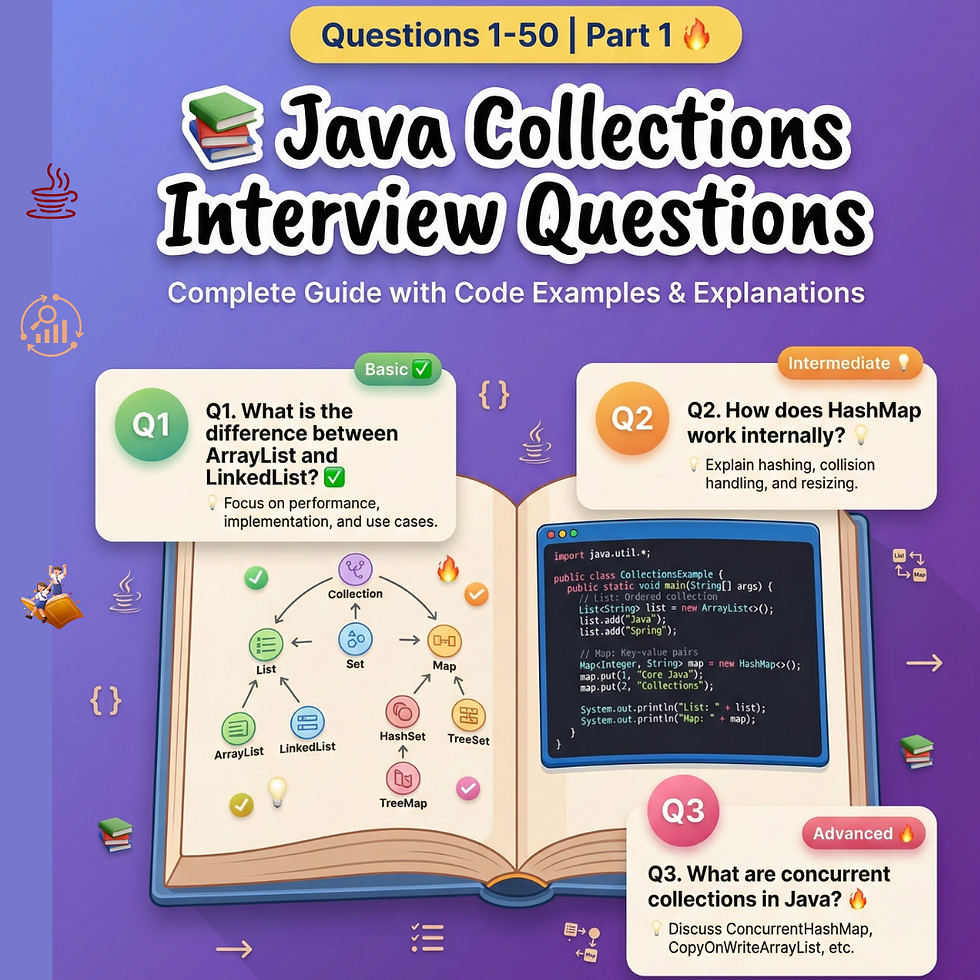
8. Explain the difference between `ArrayList` and `LinkedList`.
ArrayList: Uses a dynamic array, provides fast random access but slow insertions/deletions in the middle.
LinkedList: Uses a doubly linked list, provides faster insertions/deletions but slower random access.
Choosing between them depends on the use case, such as frequent access vs. frequent modifications.

Advanced Java Interview Questions
9. What is the difference between `final`, `finally`, and `finalize`?
final: A keyword used to declare constants, prevent method overriding, or inheritance.
finally: A block used in exception handling that always executes after try-catch.
finalize(): A method called by the garbage collector before object destruction (deprecated in recent Java versions).
Understanding these helps in writing clean and error-free code.
10. How does Java support multithreading?
Java provides built-in support for multithreading through:
Thread class: Extend this class and override `run()` method.
Runnable interface: Implement this interface and pass it to a Thread object.
Example using Runnable:
```java
public class MyRunnable implements Runnable {
public void run() {
System.out.println("Thread is running");
}
public static void main(String[] args) {
Thread thread = new Thread(new MyRunnable());
thread.start();
}
}
```
Multithreading improves application performance by executing multiple tasks concurrently.
Tips for Acing Your Java Interview
Practice coding daily: Use platforms like LeetCode or HackerRank.
Understand concepts deeply: Don’t just memorize answers.
Write clean code: Follow naming conventions and comment where necessary.
Prepare for behavioral questions: Communication skills matter.
Review Java 8+ features: Lambdas, streams, and functional interfaces are often discussed.
By focusing on these areas, you can confidently tackle Java coding interviews.
Conclusion
Mastering these top 10 Java coding interview questions and answers will boost your confidence and improve your chances of success. Keep practicing and stay updated with the latest Java developments to stay ahead in your career.
Additionally, consider exploring resources that provide in-depth insights into Java programming. This will enhance your understanding and prepare you for any unexpected questions during your interview.





Comments