3 pages from the guide: the cover, the contents (60 questions in 6 sections) and one complete question with its answer, code and interview tips.
Generics, reflection and annotations are how frameworks like Spring and Hibernate work, which is why senior interviews ask about them. This guide explains bounds, wildcards and PECS, type erasure and heap pollution with real compiler diagnostics, reflection and method handles with measured costs, dynamic proxies, and annotation processors, including four small frameworks built from scratch.
60 questions in 6 sections, 60 code examples and 21 diagrams in a 101-page PDF (2026 edition).
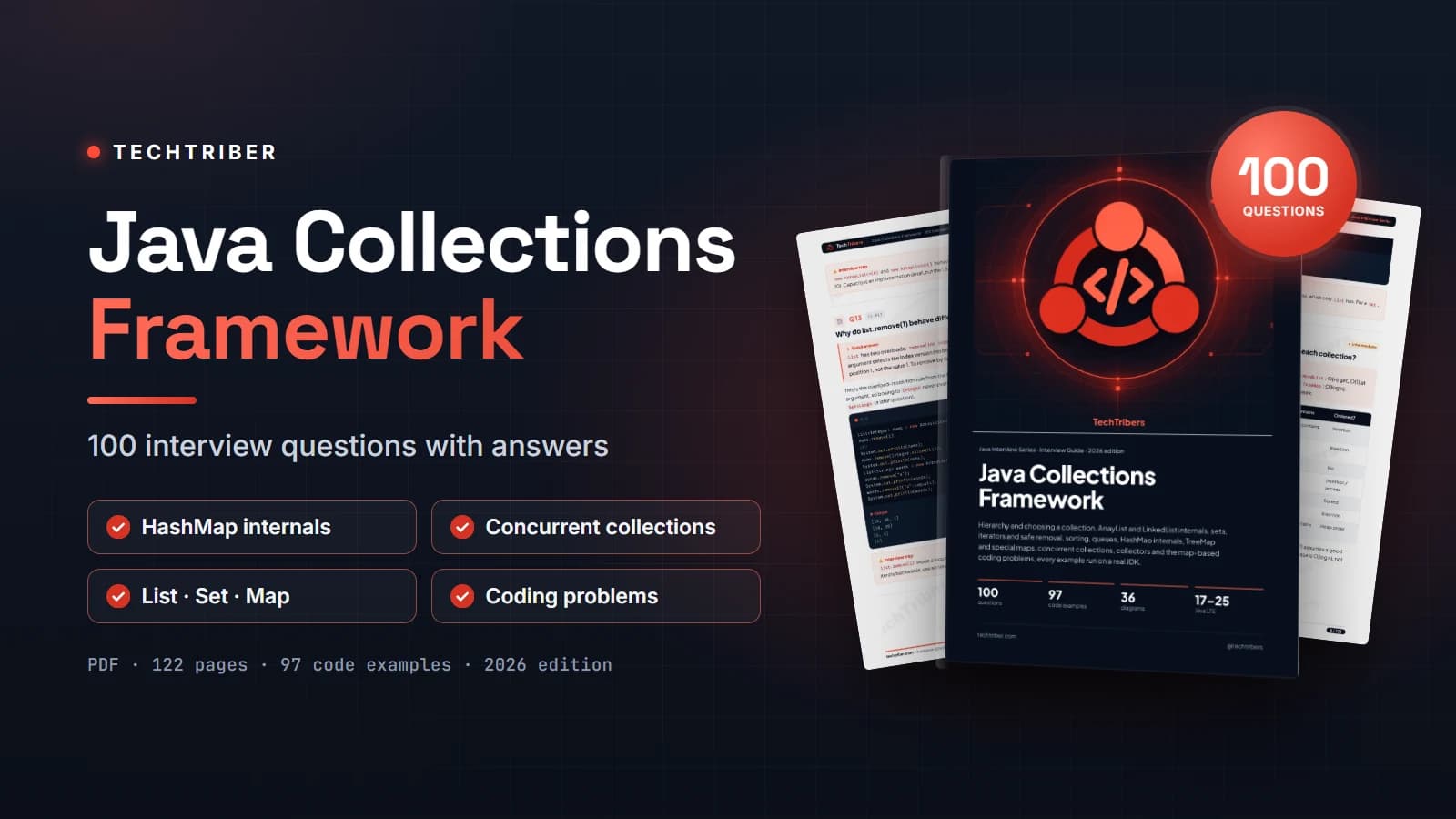
100 Java Collections Framework interview questions with detailed answers, code examples and performance tips.
No reviews yet
Type out the wildcard and erasure examples and read the compiler messages yourself. Then build one of the mini frameworks from the annotations section without looking.
f(List<String>) and f(List<Integer>) clash, and how does erasure affect overriding?Two methods whose parameter types have the same erasure would get the same JVM descriptor (f(Ljava/util/List;)V), so javac rejects them as a name clash, even though their generic signatures differ. The same rule applies across a hierarchy: a subclass method f(List<Integer>) neither overrides nor overloads an inherited f(List<String>), so it's an error. Overriding works on erasure in one direction only: a raw f(List) *is* allowed to override f(List<String>) (for migration), with an unchecked warning.
It is a digital download (PDF). After payment it appears in your Library right away.
It covers this topic in depth. It is one topic from the TechTribers Java Interview Series, which has all 23 parts (1,200+ questions) in one bundle.
No reviews yet — be the first to review this product.
A library of 12+ Java e-books covering basics, OOP, DSA, problem solving and interview prep.
No reviews yet
The all-in-one Java bundle: 3000+ interview questions, 50+ e-books, 500+ coding problems, DSA notes and bonus courses.
No reviews yet
 Tech Tribers